Claude vs ChatGPT: The Task-by-Task Verdict (Verified July 2026)
TL;DR: Claude and ChatGPT sit close on raw quality and near-identical on flagship API price. Claude wins longform writing and code reasoning. ChatGPT wins image generation, voice, and quick web research. For most people on a $20/month plan the deciding factor is not quality. It is Claude's two compounding usage caps. Every number here was verified 2026-07-10.
Google answers "claude vs chatgpt" with an AI Overview before you reach a single blue link. We pulled the July 9, 2026 US snapshot for this query. The Overview cites a Medium post, five YouTube videos, and one comparison page, morphllm, which also holds an organic top-10 spot. It earns both slots the same way: live benchmark data plus a plain verdict. So this page runs that play. Every price below comes from the OpenRouter model snapshot fetched July 10, 2026. Every task verdict is tagged to a dated source. We have not re-run SWE-bench or MMLU ourselves. Where we cite a benchmark, we name who published it.
Claude vs ChatGPT in 2026: task-by-task verdict
Claude wins longform writing and code reasoning; ChatGPT wins image generation, voice, and quick web research. Their flagship APIs cost within 10% of each other: Claude Opus 4.8 at $5/$25 per million tokens, GPT-5.6 Sol at $5/$30, both verified 2026-07-10. On the $20 plan, Claude's tighter usage caps are the real deal-breaker, not output quality.
The AI Overview and the highest-upvoted practitioner threads agree on the split. The clearest source is a four-month paid side-by-side log from r/ClaudeAI (972 upvotes, May 17, 2026): "paid for both since January. tracked which one I actually used per task type." That format, tasks over tribes, is the honest way to read this matchup.
| Claude | ChatGPT | |
|---|---|---|
| Maker | Anthropic | OpenAI |
| Flagship model (Jul 2026) | Claude Opus 4.8 | GPT-5.6, Sol tier |
| Context window | 1,000,000 tokens | 1,050,000 tokens |
| Flagship API price (in / out per 1M) | $5 / $25 | $5 / $30 |
| $20 consumer plan | Claude Pro | ChatGPT Plus |
| Best at | Longform writing, code reasoning | Image generation, voice, web research |
| Weak at | Tighter usage caps, no in-chat images | More formulaic prose, drift on huge files |
| In-chat image generation | No | Yes, DALL-E |
| Native voice mode | Limited | Advanced Voice Mode |
Prices and context windows from the OpenRouter snapshot, verified July 10, 2026. Model names reflect the July 2026 lineup.
Disclosure: we have no affiliate or business tie to Anthropic, OpenAI, or OpenRouter as of publication. If that changes, this paragraph will say so. We ran no vendor demos and took no briefings. Our funding model is in our editorial policy.
For writing: which one wins
Claude wins longform writing. The four-month log is blunt about it: "for writing (longform, analysis, structured docs): claude wins. opus 4.7 and sonnet 4.6 both better than gpt-5 at maintaining voice and structure over 2000+ words. its not close." Google's own AI Overview reaches the same verdict, crediting Claude with "highly human-like prose" that "avoids robotic AI-isms."
The failure mode people cite for ChatGPT is not weak grammar. It is tone. A 4,215-upvote r/ClaudeAI post from May 2026 mocks the reflex praise: "chatgpt would've been glazing me." A separate thread describes GPT output that "will only speak to me in lists and bullets, and will go over the top about everything." For a marketer shipping a 2,000-word brief in a fixed voice, that sycophancy is rework. Editors notice it first. The praise inflates length and buries the point.
Claude is not flawless here. On short copy it over-cites and pads. The same log notes Claude "over-cites and writes paragraphs when I wanted a list." The models named in these threads were Opus 4.7, Sonnet 4.6, and GPT-5. By our July 10, 2026 snapshot they had iterated to Opus 4.8, Sonnet 5, and the GPT-5.6 family. Treat the version tags as dated. The direction has held across four straight release cycles: for structured prose over 2,000 words, Claude keeps voice better.
For coding: which one wins
Claude wins code reasoning; the gap on raw code generation is narrower. In a coding comparison, that distinction matters more than any single score. The four-month log separates them precisely: "for code reasoning (not generation, reasoning): claude wins. specifically on 'explain why this is failing' or 'what architecture would you pick here.' sonnet feels like talking to a senior eng."
Two structural facts back that up. Claude's flagship context window is 1,000,000 tokens, verified 2026-07-10. It holds a large codebase in one pass without dropping earlier files. The AI Overview credits Claude with leading "in handling large codebases and documents without losing context." Second, Artifacts renders code, charts, and spreadsheets in a panel beside the chat. You edit and run against a live view. No scrolling a dead transcript.
ChatGPT is not behind on generation. Its Codex-tuned models ship fast, clean code for autocomplete and scaffolding, and its tools run the result in line. The split is reasoning versus throughput. Claude explains the bug; ChatGPT types the fix quicker.
On benchmarks, be skeptical of anyone quoting a single number. SWE-bench, HumanEval, and MMLU are the scores comparison pages lean on. Morphllm publishes a benchmark table for exactly this query. We did not re-run them. The leaderboards move within weeks of each release. Two builder threads set the honest frame. One: "Use DETERMINISTIC CODE for every possible task." Another, from March 2026: "My ai agents need more babysitting than the intern we fired last year." A three-point benchmark lead does not fix babysitting. For scored, price-weighted coding picks, see our best LLM for coding breakdown.
For research and web tasks: which one wins
ChatGPT wins quick web research and multimodal work. The four-month log again: "for quick web research: gpt-5 wins. faster, cleaner formatting, fewer hedges. claude over-cites and writes paragraphs when I wanted a list." The AI Overview lists the same edge, plus the features Claude "lacks entirely": in-chat image generation via DALL-E, natural real-time voice, and a large plugin and connector ecosystem.
This is the honest-negative for Claude. It does not generate images in a chat at all. Its voice mode trails ChatGPT's Advanced Voice Mode, which the log calls "genuinely conversational." Say a real-estate agent wants a listing photo restyled, a quick market lookup, and a spoken back-and-forth on the drive. ChatGPT does that whole loop in one app. Claude does none of the image or voice half.
The two-app framing also hides the wider field. For pure web research, some users route to Gemini Pro or Perplexity; for cost-sensitive bulk work, Grok and DeepSeek undercut both on price. A December 2025 thread ran one PDF-extraction task across Opus, Gemini 3, GPT-5.x, and Kimi K2 and reported only Opus finished it. One task is not a benchmark. The point stands: "claude vs chatgpt" is the popular framing, not the whole market.
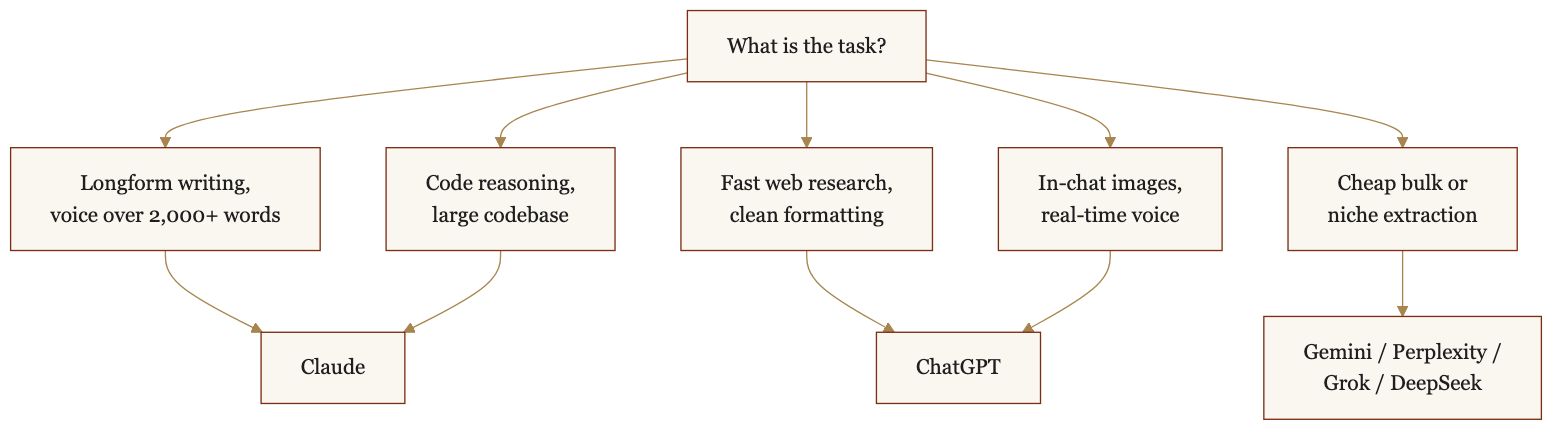 Pick by task, not by tribe: Claude for longform writing and code reasoning, ChatGPT for fast web research and multimodal, other models for cheap bulk work.
Usage limits and subscriptions: the real deal-breaker
For most $20/month subscribers, usage caps decide this, not quality. This is the axis competitors skip. It is where the highest-upvoted threads converge. The headline is a 906-upvote r/ClaudeAI post from February 23, 2026: "Claude is the better product. Two compounding usage caps on the $20 plan are why OpenAI keeps my money." The author prefers Claude for editing a book. He stays on ChatGPT Plus for the message volume.
Two caps compound on Claude Pro: a five-hour rolling session limit and a weekly limit. A widely shared open letter to Anthropic (1,988 upvotes, March 28, 2026) reports that "two standard prompts during peak hours can burn your entire 5-hour session," with "no real-time token counter" and "no published token budgets. No way to plan." Even Max 20x subscribers, the $200/month tier named in that thread, report usage "jumping from 21% to 100% on a single prompt." A separate 927-upvote post found a Pro weekly limit "already mostly drained by mid-week" while the user stuck to Sonnet and Haiku.
Google's AI Overview corroborates the direction: at "the standard $20/month tier, Claude can hit rate limits faster if you're executing heavy, multi-turn workloads, whereas ChatGPT offers more generous message volume." ChatGPT is not the better model in these threads. It is the better-structured plan.
ChatGPT Plus is not unlimited either. It caps GPT-5-class messages and slows at peak load. The difference is that its limits are legible. You know roughly what you get per window. Claude's caps move without warning and carry no counter.
| Your profile | Pick | Why |
|---|---|---|
| Heavy longform writer or editor | Claude Pro | Best voice retention over 2,000-plus words. Budget for the mid-week cap. |
| High-volume, multi-turn daily driver | ChatGPT Plus | More predictable message volume on the $20 tier. |
| Wants images, voice, and web in one app | ChatGPT Plus | DALL-E, Advanced Voice Mode, and browsing are native. |
| Runs heavy agent or coding loads | Claude Max ($100 or $200) | Buys headroom past the Pro caps. Confirm current limits first. |
| Only $20 to spend, mixed tasks | Neither alone | Many prosumers keep both $20 plans and route by task. |
Consumer subscription tiers cited from the dated threads above; verify current numbers at each vendor's pricing page. Our live-verified figures are the API prices.
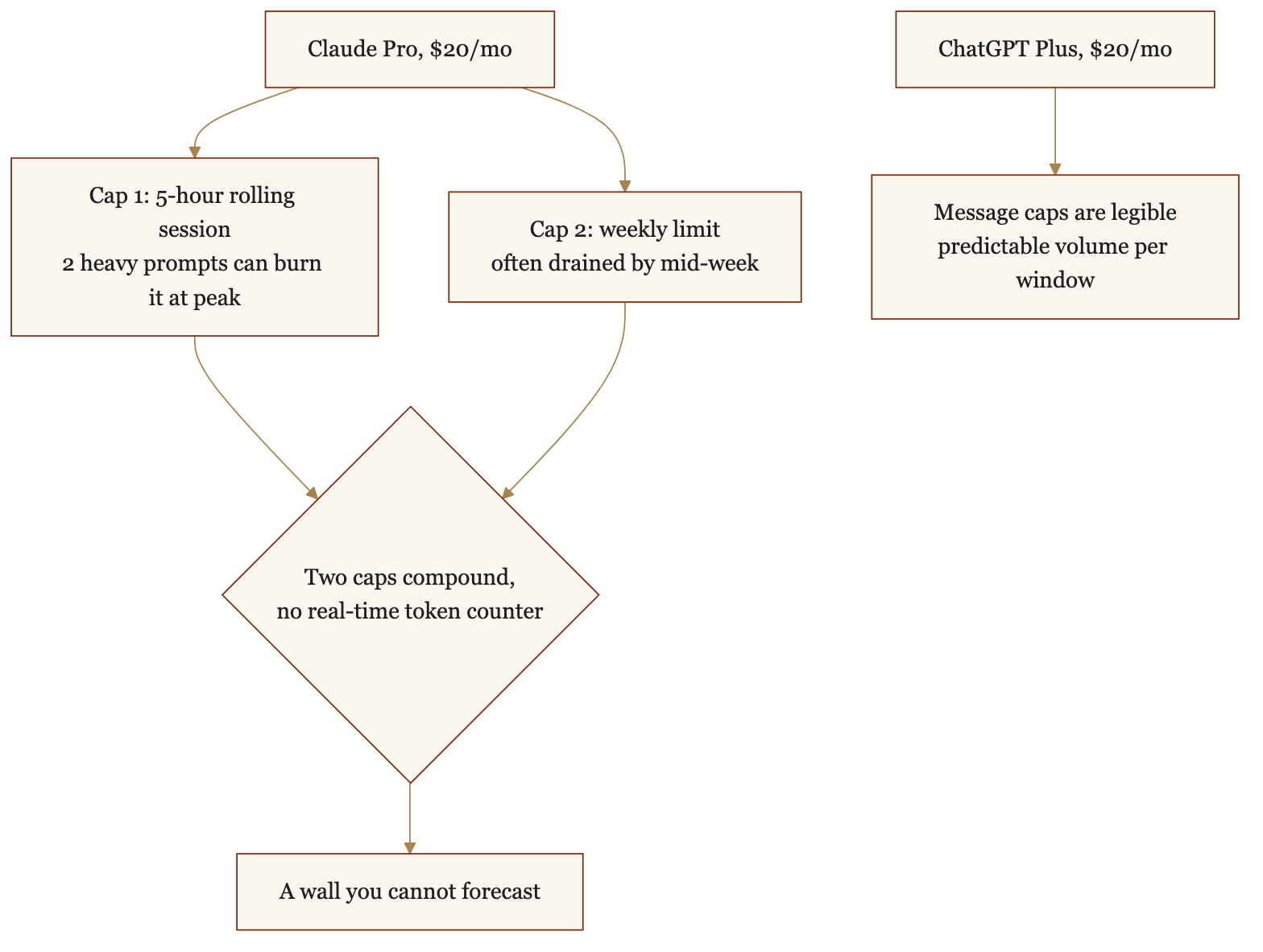 On Claude Pro's $20 plan a 5-hour session cap and a weekly cap compound with no real-time token counter; ChatGPT Plus caps are less generous on quality but more predictable per window.
Claude vs GPT: models vs product
Claude and GPT are the models; Claude and ChatGPT are the products. The distinction settles half the arguments online. The naming trips buyers because Anthropic reuses one word for the app and the model. OpenAI does not. ChatGPT is OpenAI's consumer app, and in July 2026 it runs on the GPT-5.6 family (Luna, Terra, Sol tiers in our snapshot). Claude is both Anthropic's app and its model line: Opus, Sonnet, and Haiku. So "claude vs gpt" compares raw models. "Claude vs chatgpt" compares a model line against a full product, one with image, voice, and browsing bolted on.
That gap explains the divergent scoreboards. On the model layer, the two trade blows by task. On the product layer, ChatGPT wins. Its ecosystem is wider and its consumer reach is larger. A February 2026 r/ClaudeAI post (1,375 upvotes) frames the split from the enterprise side, claiming Anthropic "commands roughly 40% of enterprise AI spending" while ChatGPT holds an "800 million weekly users" consumer lead. Treat those as community-reported figures, not audited facts, but the shape is right: OpenAI leads the consumer product race, Anthropic leads the model-trust race.
| Layer | Claude | ChatGPT / GPT |
|---|---|---|
| Consumer app | Claude (web, mobile) | ChatGPT (web, mobile) |
| Model line | Opus 4.8, Sonnet 5, Haiku 4.5 | GPT-5.6 Sol, Terra, Luna |
| Native image generation | No | Yes, DALL-E |
| Native voice | Limited | Advanced Voice Mode |
| API access | Yes | Yes |
If your decision is really "which model," ignore the ecosystem row and read the pricing table next. If it is "which app for daily life," the ecosystem row decides it.
API pricing side by side (live)
The subscription vs API decision is the exit from the caps above. Pay per token through the API and the message limits disappear; you pay only for what you send. At the flagship tier, Claude and GPT price within 10% of each other. All figures below come from the OpenRouter snapshot fetched 2026-07-10. We converted them to US dollars per million tokens. We compare like tiers: flagship, workhorse, and budget.
| Tier | Claude model | In / Out per 1M | GPT model | In / Out per 1M |
|---|---|---|---|---|
| Flagship | Claude Opus 4.8 | $5 / $25 | GPT-5.6 Sol | $5 / $30 |
| Workhorse | Claude Sonnet 5 | $2 / $10 | GPT-5.6 Terra | $2.50 / $15 |
| Budget | Claude Haiku 4.5 | $1 / $5 | GPT-5.6 Luna | $1 / $6 |
Verified 2026-07-10 from OpenRouter /api/v1/models. Context windows: Claude flagships 1,000,000 tokens (Haiku 200,000); GPT-5.6 family 1,050,000 tokens.
Sticker prices hide the real bill, so here is a worked example on one workload: 5,000,000 input tokens and 1,000,000 output tokens per month, a plausible load for a single analysis assistant. Claude Opus 4.8 costs $25 input plus $25 output, so $50. GPT-5.6 Sol costs $25 plus $30, so $55, a 10% premium. Drop to the workhorse tier and the gap widens: Claude Sonnet 5 runs $20 for the month against GPT-5.6 Terra at $27.50, so Claude is about 27% cheaper for the same job. At the budget tier they nearly tie: Haiku 4.5 at $10, Luna at $11. So the cheaper family flips by tier. Claude leads on the workhorse, and the two draw at the extremes.
Prompt caching cuts input cost by roughly 10x on both sides when you resend a stable context: cached reads run $0.50 per million on Opus 4.8 and Sol, versus the $5 first-read price. For the full breakdown, see Claude API pricing and OpenAI API pricing. We keep these numbers current from the same OpenRouter feed, explained in our OpenRouter review and data disclosure.
FAQ: Why is everyone switching from ChatGPT to Claude?
Why is everyone switching from ChatGPT to Claude?
Two reasons dominate the early-2026 migration threads: writing quality and sycophancy fatigue. Users report Claude holds voice over 2,000-plus words better than GPT, and complain that ChatGPT over-praises them. Claude overtook ChatGPT on the Apple App Store in February 2026. The reverse flow is real too: tighter usage caps push some users back to ChatGPT.
What can Claude do that ChatGPT cannot?
Claude's Artifacts panel renders code, charts, and documents side by side with the chat, and it holds long codebases in context without drifting. Its 1,000,000-token window ingests large files in one pass. What Claude cannot do: generate images inside chat, or match ChatGPT's Advanced Voice Mode. Those remain ChatGPT-only.
Why do people prefer Claude AI?
In dated side-by-side tests, prosumers pick Claude for prose that avoids robotic AI-isms and for code reasoning that one r/ClaudeAI user (May 2026) said feels like talking to a senior engineer. The preference is task-specific, not universal. The same users keep ChatGPT for images, voice, and fast web lookups.
Is Claude better than ChatGPT?
For longform writing and code reasoning, yes, on the weight of dated user comparisons. For image generation, voice, web browsing, and predictable message limits on the $20 plan, no. Their flagship APIs price within 10% ($5/$25 versus $5/$30 per million tokens, verified 2026-07-10). Pick by task, not by brand.
Originally published July 10, 2026. Last updated July 10, 2026. API prices last verified July 10, 2026 from the OpenRouter /api/v1/models snapshot, converted to US dollars per million tokens. Community evidence: top threads from r/ClaudeAI and Hacker News in the LLM-comparison corpus, plus the July 9, 2026 US Google snapshot for "claude vs chatgpt." Benchmark claims are attributed to their publishers and were not independently re-run. This page compares tools from cited sources only; it is not professional advice.