OpenRouter Review: One API for 347 Models, and What It Actually Costs
TL;DR: OpenRouter puts 347 models from 56 providers behind one API key (snapshot July 10, 2026). It adds no per-token markup on standard routes: Claude Opus 4.5 lists at $5 in and $25 out per million, the same as Anthropic charges directly. It earns on the credit-deposit fee (about 5.5% plus $0.35 per card top-up) and a 5% bring-your-own-key fee. Buy it for breadth and one bill. Plan for the single-vendor dependency.
OpenRouter puts 347 models behind one key. We know the count because we pull that list every day. This site's LLM pricing pages run on OpenRouter's public /api/v1/models feed, snapshotted July 10, 2026. That gives us a first-hand view of one slice of the product, the data layer, and an obligation to disclose it, which we do in full at the bottom of this page. We have no affiliate or business tie to OpenRouter as of publication. This OpenRouter review separates what the unified API does from what it claims, with the per-token math the vendor never spells out.
OpenRouter review: the verdict and at a glance
OpenRouter is the fastest way to reach 347 models (56 providers, July 10, 2026 snapshot) from one key and one bill, with model routing across all of them and no per-token markup on standard routes. The real cost sits on credit deposits and a 5% bring-your-own-key fee. Pick it for breadth and speed. Budget for the fact that one company now sits between your app and every model you call.
| OpenRouter | |
|---|---|
| What it is | An API aggregator. One OpenAI-compatible endpoint in front of many providers. |
| Models and providers | 347 models, 56 provider namespaces (July 10, 2026 snapshot). |
| Per-token markup | None on standard routes. Provider price passed through. |
| How it earns | Credit-deposit fee (about 5.5% plus $0.35 per card top-up) and a 5% fee on bring-your-own-key calls. |
| Free tier | 26 models at a $0 prompt price in the snapshot. No subscription. |
| Routing and fallback | Automatic reroute to another provider on failure. Rankings and a Fusion routing product on top. |
| Biggest risk | Single-vendor dependency. Held-funds complaint on March 29, 2026; an outage on August 28, 2025. |
| Best fit | Teams that want breadth, one bill, and no infrastructure. |
| Not for | Regulated data you cannot route through a third party, or shops that need self-hosted control. |
Model count and prices verified July 10, 2026 from the OpenRouter /api/v1/models snapshot. Fees are OpenRouter's documented figures at publication; verify the current numbers on openrouter.ai.
Disclosure: we have no affiliate or business relationship with OpenRouter as of publication. We do consume its free public model list to power our LLM pricing pages. If a paid relationship ever starts, this paragraph will say so. Our funding model is in our editorial policy.
What OpenRouter actually is: a router, not a model
OpenRouter is an LLM API aggregator: one OpenAI-compatible endpoint that routes your request to 347 models from 56 providers (July 10, 2026 snapshot), with automatic fallback if a provider fails. It does not build models. You get one key, one bill, and provider prices passed through, minus a credit-deposit fee.
The 56 providers are led by OpenAI (68 model entries), Qwen (49), Google (28), Mistral (19), Anthropic (15), Meta Llama (12), and DeepSeek (11). Context windows reach 2,000,000 tokens on xAI Grok 4.20. So the pitch is real: swap openai/gpt-5.6 for anthropic/claude-opus-4.5 by changing one string, with no new account, key, or invoice.
Two features sit on top of the routing. The OpenRouter rankings publish token usage stats that move markets: Grok became its most-used model in September 2025, and a then-unnamed model, Hy3, topped the rankings in May 2026. It also ships a Fusion routing product (June 15, 2026) and ran a "State of AI" study across 100 trillion tokens in December 2025. That token flow is the asset: OpenRouter raised a $113M Series B on May 30, 2026 on the strength of sitting in the middle of it.
The markup question: what you actually pay per token
This is the question the community asks and the vendor does not answer plainly. The short version: OpenRouter does not mark up tokens on standard routes. It passes the provider's price through.
We checked it against a provider we can verify. On July 10, 2026, OpenRouter lists these Claude prices, and each one equals Anthropic's own API price to the cent.
| Model (July 10, 2026) | OpenRouter input / output per 1M | Anthropic direct per 1M | Per-token markup |
|---|---|---|---|
| Claude Opus 4.5 | $5.00 / $25.00 | $5.00 / $25.00 | 0% |
| Claude Sonnet 4.5 | $3.00 / $15.00 | $3.00 / $15.00 | 0% |
| Claude Haiku 4.5 | $1.00 / $5.00 | $1.00 / $5.00 | 0% |
So where does OpenRouter make money? On the money in, not the tokens out. Buying credits carries a payment fee. OpenRouter's documented card fee at publication is roughly 5.5% plus about $0.35 per top-up. The fixed $0.35 matters more than it looks, because it hits small deposits hardest. Here is the arithmetic the pricing page leaves you to do.
- A $10 card top-up: fee of about $0.90, so roughly $9.10 lands as usable OpenRouter credits. Effective cost about 9%.
- A $100 card top-up: fee of about $5.85, so roughly $94.15 lands as usable credit. Effective cost about 5.9%.
Top up in large amounts and the effective fee falls toward the base rate. Top up $10 at a time and you pay nearly double the percentage. That is the real OpenRouter markup, and it is a deposit fee, not a token fee.
One more line item. Bring your own provider key (BYOK) and OpenRouter charges 5% of what the request would have cost at the provider, deducted from your credits. A call that would run $1.00 on Anthropic's own key costs $0.05 in OpenRouter credit on top. You are paying 5% for the routing layer while the inference bill goes to your own provider account. Fees change, so verify the current numbers before you budget.
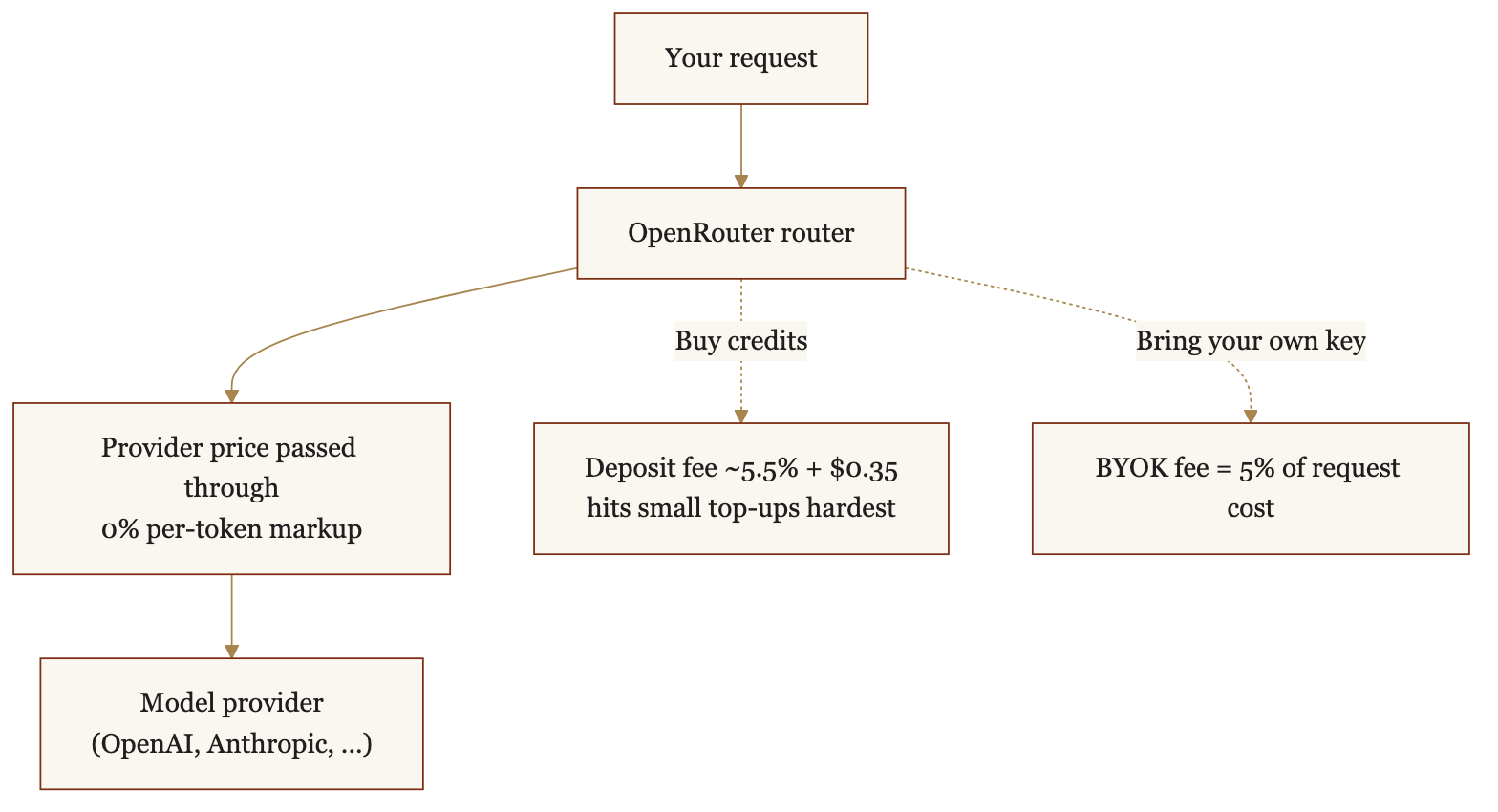 OpenRouter passes per-token prices through at 0% markup; it earns on the credit-deposit fee (~5.5% + $0.35, worst on small top-ups) and a 5% BYOK fee. Fees per OpenRouter's published figures, July 10, 2026.
Fallbacks, BYOK and uptime in practice
Automatic fallback is the feature that earns its keep. Name a primary model and an ordered list of fallback models, and OpenRouter reroutes to the next provider when one errors or times out. For a production app on a single frontier model, that removes a class of 3 a.m. pages. BYOK layers on top: route through your own provider keys and keep OpenRouter as the switch.
Now the honest part. We have run OpenRouter's data-feed integration first-hand for months. We have not run a controlled routing-and-failover benchmark with dated latency and success-rate numbers. So we will not print uptime or latency figures we did not measure. When we run that suite, the numbers land here with a changelog entry and our testing protocol linked.
What the record does show is the dependency cost. OpenRouter posted an outage on August 28, 2025. On March 29, 2026, an r/openrouter thread titled "OpenRouter is holding funds hostage" described held prepaid credits and slow support. One thread is not a pattern, but prepaid credits with a single company are a real exposure. Keep balances small, or keep BYOK ready as an exit.
Privacy is the other consideration of any proxy. Your prompt reaches OpenRouter before it reaches the model provider, so you trust two parties, not one. OpenRouter exposes data and logging controls and can exclude providers that train on inputs. For privileged, medical, or regulated data, read its data policy and the downstream provider's terms first. A router does not remove the confidentiality question. It adds a hop to it.
OpenRouter vs LiteLLM vs Eden AI
The AI Overview for "openrouter alternatives" on July 9, 2026 named the same short list every competitor page names: LiteLLM, Eden AI, Portkey. Here is the honest split.
| OpenRouter | LiteLLM | Eden AI | |
|---|---|---|---|
| Model | Hosted aggregator. | Open-source, self-hosted proxy. | Hosted multi-service platform. |
| You run | Nothing. | Your own server. | Nothing. |
| Providers | 347 models, 56 namespaces (snapshot). | 100+ providers, OpenAI-compatible. | Multimodal APIs beyond text. |
| Credits held by | OpenRouter. | Nobody. You use your own keys. | Eden AI. |
| Best for | Breadth and speed, one bill. | Governance, data staying in-house. | Non-text tasks, a European vendor. |
| Trade-off | Single-vendor dependency. | Setup and maintenance are on you. | Fewer raw text models than OpenRouter. |
LiteLLM is the real fork in the road. Same one-endpoint convenience, but you host it, you hold your own keys, and no third party sits on your credits: more work, more control. Eden AI, pitched as a European alternative (Hacker News, April 26, 2026), leans multimodal for teams that want an EU vendor. OpenRouter wins on raw text-model breadth and zero infrastructure. It loses to LiteLLM the moment your requirement is "our traffic must stay in our systems."
Disclosure: how this site uses OpenRouter data
We call this an OpenRouter review, so we owe you the provenance. Our LLM pricing and comparison pages, including the best LLM for coding and Claude API pricing pages, read model IDs, context lengths, and per-token prices from OpenRouter's public /api/v1/models endpoint. We snapshot it with a date, and the figures in this article come from the July 10, 2026 snapshot of 347 models.
That means two things. First, when we quote a price, we quote what OpenRouter lists, which for the models we spot-checked equals the provider's own price. Second, our familiarity is genuine but bounded: we exercise the data layer daily and have not run a full production workload through the routing and fallback layer. We flag that gap rather than paper over it. We take no payment from OpenRouter and run no referral links as of publication, and will label this page the day that changes.
FAQ
Is OpenRouter free to use?
There is no subscription. You pay per token at the provider price, and the July 10, 2026 snapshot lists 26 models at a $0 prompt price for free testing. Paid usage runs on prepaid credits, and topping up carries a payment fee of roughly 5.5% plus about $0.35 per card deposit.
Does OpenRouter add a markup on tokens?
Not on the per-token price for standard routes. On July 10, 2026, Claude Opus 4.5 lists at $5 input and $25 output per million on OpenRouter, matching Anthropic's direct price. OpenRouter earns on the credit-deposit fee and a 5% bring-your-own-key fee. Verify current fees before you budget.
Is my data private when I use OpenRouter?
Your prompts pass through OpenRouter servers before reaching the provider, so you trust two parties instead of one. OpenRouter lets you set logging policies and exclude providers that train on inputs. For privileged or regulated data, read its data policy and the provider terms first.
How reliable is OpenRouter?
Automatic fallback reroutes a failed request to another provider, which helps day to day. But OpenRouter is a single point of dependency: it posted an outage on August 28, 2025, and an r/openrouter thread on March 29, 2026 complained about held funds. We have not run a controlled uptime benchmark yet.
OpenRouter vs LiteLLM, which should I pick?
Pick OpenRouter for a hosted service with one bill and no infrastructure. Pick LiteLLM, an open-source self-hosted proxy, when you need to keep traffic inside your own systems, bring your own provider keys, and avoid a third party holding credits. LiteLLM is work you run. OpenRouter is work you outsource.
Originally published July 10, 2026. Last updated July 10, 2026. Model count and prices verified July 10, 2026 against the OpenRouter /api/v1/models snapshot of 347 models. Fees are OpenRouter's documented figures at publication and should be re-checked on openrouter.ai. Community evidence: Hacker News and r/openrouter threads from the July 9, 2026 corpus. Our testing protocol is at how we test; a controlled routing and failover benchmark for OpenRouter will be added with a changelog entry.
This OpenRouter review draws on a live data-feed integration and cited public sources. We have not run a full production routing benchmark. It is not financial or procurement advice. For a purchase that touches regulated data, consult your own compliance review.